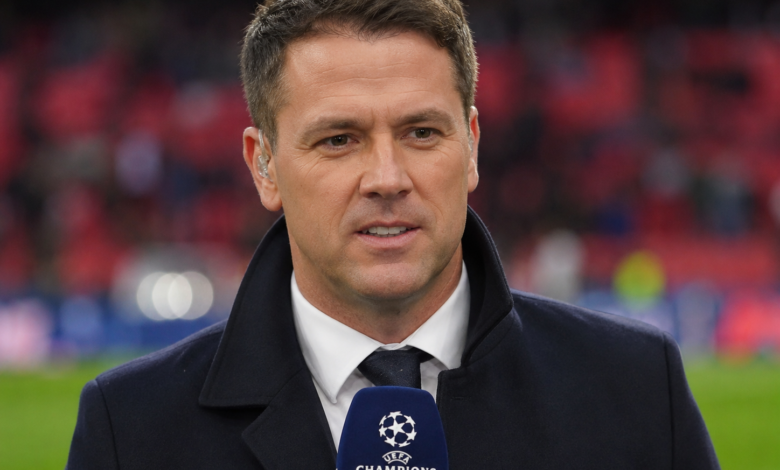
Michael Owen became a football star almost before he had time to understand how quickly his life was changing. A teenager from Chester, England, he went from Liverpool academy prospect to Premier League sensation, England international, and Ballon d’Or winner in only a few extraordinary years.
His career is remembered for explosive acceleration, sharp finishing, and an ability to score in situations where defenders seemed to have the advantage. Michael Owen was never the biggest striker on the pitch, but his movement and timing allowed him to compete against much stronger defenders.
There is also a fascinating second side to his story. His career included some of the highest achievements available to an English footballer, but injuries and changing circumstances later affected his pace and consistency. That combination of spectacular highs and difficult periods makes his career especially interesting to look back on.
Who Is Michael Owen?
Michael James Owen was born on December 14, 1979, in Chester, England. He grew up with football around him and eventually joined Liverpool’s youth system, where his goalscoring ability quickly became difficult to ignore.
Liverpool’s official records show that Owen made his first-team debut in May 1997, at only 17 years old. He scored just 16 minutes after coming on against Wimbledon, immediately announcing himself as a player capable of handling senior football.
That debut was more than a promising beginning. It was the opening chapter of a career that would eventually take him to some of Europe’s biggest clubs and make him one of England’s most recognizable footballers of his generation.
The Liverpool Breakthrough
Liverpool was where Michael Owen became a household name. His first full senior season, 1997–98, was remarkable for a teenager. He scored 23 goals in all competitions, showing that his finishing ability was not simply a temporary burst of youth-team form.
His biggest weapon was speed. Owen could run beyond defensive lines before opponents had time to react, and once he reached the penalty area, his finishing was usually calm and precise.
Liverpool’s official history credits him with 158 goals in 297 Michael Owen appearances across his seven seasons with the club. He also won the FA Cup, two League Cups, the UEFA Cup, and the UEFA Super Cup during his time at Anfield.
The 1998 World Cup Made Him a Star
Owen’s reputation exploded beyond England during the 1998 FIFA World Cup in France. He was only 18, yet his performances quickly convinced supporters that he belonged on the biggest international stage.
The defining moment came against Argentina in the round of 16. Owen collected the ball, drove forward at remarkable speed, moved past defenders, and finished the attack with the confidence of a far more experienced player.
England eventually lost the match on penalties, but Owen’s goal became one of the tournament’s iconic moments. Liverpool later described the performance as the moment that helped make the teenager a global football phenomenon.
His Peak at Liverpool
The early promise eventually turned into sustained excellence. Michael Owen remained Liverpool’s main goalscoring threat throughout the late 1990s and early 2000s, regularly reaching double figures despite the physical demands placed on a fast, explosive striker.
The 2000–01 season was especially important. Liverpool won the FA Cup, League Cup, and UEFA Cup, completing a memorable cup treble. Owen played a central role in that success, combining with teammates such as Emile Heskey while continuing to produce decisive goals.
His most famous Liverpool moment came in the 2001 FA Cup final against Arsenal. Liverpool were trailing 1–0 late in the match before Michael Owen scored twice in the final seven minutes to turn the game around. The comeback became one of the defining moments of his career.
Winning the Ballon d’Or
The achievements of 2001 helped Michael Owen reach the highest individual honor in European football. He won the Ballon d’Or that year, becoming the first Liverpool player to receive the award.
UEFA’s historical list confirms Owen as the 2001 Ballon d’Or winner, ahead of a field that included many of Europe’s biggest stars.
Real Madrid’s official history also highlights the significance of the achievement, noting that Owen became only the fourth English player to win the award after Stanley Matthews, Bobby Charlton, and Kevin Keegan.
For an English striker in his early twenties to win the award was extraordinary. It placed Owen in a very exclusive group and confirmed that his best performances were being recognized beyond England.
More Success Before Leaving Liverpool
Michael Owen goals did not stop after the Ballon d’Or. He scored 28 goals in each of the 2001–02 and 2002–03 seasons, according to Liverpool’s official history. The latter campaign also included a goal in the League Cup final against Manchester United.
By the end of his Liverpool career, he had established himself as one of the club’s most productive forwards of the era. His combination of acceleration and finishing made him extremely difficult to defend when he was fully fit.
Still, the relationship between player and club had become more complicated. Liverpool’s progress had stalled somewhat, and managerial changes were taking place. When Rafael Benítez arrived in 2004, Michael Owen decided that a move abroad was the next step.
The Move to Real Madrid
In 2004, Michael Owen joined Real Madrid. It was one of the biggest transfers of his career and placed him inside one of the most glamorous squads in world football.
The environment was extraordinary. Owen shared the dressing room with players such as Ronaldo, Raúl, Zinedine Zidane, Luís Figo, and David Beckham. Real Madrid’s official profile says Owen played 45 competitive matches and scored 16 goals during his single season in Spain.
His time in Madrid was not a disaster by any reasonable statistical measure. Sixteen goals in 45 competitive matches is a respectable return. The problem was that he was competing for attention and playing time in a squad packed with global superstars.
Why Did He Leave Real Madrid?
After one season, Owen returned to England with Newcastle United. The move surprised some supporters because he had been playing for one of the world’s most famous clubs.
Yet football careers are rarely determined by statistics alone. Playing regularly, fitting into a manager’s tactical plans, and maintaining confidence can be just as important.
For Michael Owen, the move to Newcastle represented an opportunity to become the focal point of a team again. Unfortunately, injuries became an increasingly significant issue during the later part of his career.
Newcastle United and the Injury Problems
Owen joined Newcastle in 2005 and initially gave supporters plenty of reasons for optimism. His reputation as a world-class finisher remained intact, but repeated injuries made it difficult for him to build the kind of uninterrupted run of games he had enjoyed earlier in his career.
The physical qualities that had made him so dangerous were also part of the problem. Michael Owen relied heavily on explosive acceleration, and injuries affecting his legs and hamstrings could have a greater impact on his style than they might have on a less speed-dependent striker.
His Newcastle period therefore became a mixture of goals, important performances, missed matches, and frustration. The contrast with his early Liverpool years was becoming increasingly noticeable.
Manchester United Chapter
In 2009, Michael Owen made one of the more unexpected moves of his career by joining Manchester United as a free agent.
The transfer created plenty of discussion. Owen had once been one of Liverpool’s most celebrated players, and Manchester United were Liverpool’s historic rivals. The move therefore carried an obvious emotional dimension.
Owen later explained in a Liverpool interview that he had hoped for a return to Anfield but that Liverpool were not interested at the time. He said Manchester United, Everton, and Hull City were among the serious options before he chose United.
The Famous Manchester Derby Goal
One of the highlights of Owen’s Manchester United career came against Manchester City in September 2009.
The match was already dramatic, with the score level at 3–3 deep into stoppage time. Owen found space and finished a late attack to give United a 4–3 victory.
It was exactly the kind of moment that had defined his best years: limited time, a crucial opportunity, and a calm finish under enormous pressure.
The goal did not restore his career to its Liverpool-era heights, but it gave him another unforgettable chapter in Premier League history.
His Final Club Was Stoke City
After Manchester United, Owen joined Stoke City for the 2012–13 season. By then, injuries and age had reduced the speed that once separated him from defenders.
He made only a limited number of appearances and scored once before announcing his retirement from professional football at the end of the season.
The decision marked the end of a career that had started so dramatically at Liverpool. Owen had experienced almost every extreme football could offer: teenage fame, major trophies, international glory, the Ballon d’Or, elite European football, injuries, and a gradual decline.
Michael Owen and England
Owen’s international career was just as memorable as his club career. He won 89 caps for England and scored 40 goals, figures listed by both Liverpool and Real Madrid in their official profiles.
He played at several major international tournaments, including the 1998 and 2002 World Cups. His speed made him particularly dangerous against teams that played with a high defensive line.
The 1998 tournament established him as a national hero, while his performances in later competitions reinforced his status as one of England’s most important attacking players of his generation.
Life After Professional Football
Retirement did not mean disappearing from football. Michael Owen has remained involved in the sport through broadcasting, punditry, and public appearances.
He has also developed interests away from the football pitch, particularly in horse racing and breeding. That has given him a second professional identity beyond his playing career.
His post-playing life reflects something common among elite athletes: once the daily routine of training and competition disappears, they have to build a new relationship with the sport and with public life.
Michael Owen’s Legacy
How should Michael Owen ultimately be remembered? The answer depends on which part of his career you emphasize.
If you focus on his peak, he was extraordinary. He won the Ballon d’Or, scored 158 times for Liverpool according to the club’s current official records, won major trophies, and became an England star before his twentieth birthday.
If you focus on the second half of his career, the story becomes more complicated. Injuries prevented him from consistently reproducing the explosive performances that had made him famous.
That contrast does not diminish what he achieved. In fact, it makes his story more compelling. Few footballers reach the level Owen reached so young, and even fewer can say they won Europe’s most prestigious individual award.
Final Thoughts on Michael Owen
Michael Owen remains one of the most fascinating English strikers of the modern era. His rise was incredibly fast: a teenage Liverpool debut, an unforgettable World Cup goal, major trophies, and a Ballon d’Or all arrived before he had reached his mid-twenties.
His Liverpool record remains the clearest evidence of his peak. The club credits him with 297 appearances and 158 goals across his seven seasons, alongside four major trophies.
His later moves to Real Madrid, Newcastle United, Manchester United, and Stoke City created a more complicated second half to his playing career, particularly as injuries affected his pace and availability. Yet those chapters also produced memorable moments, including his time alongside Madrid’s superstar squad and his dramatic Manchester derby winner.
Ultimately, Michael Owen should be remembered not simply as a player whose career declined after injuries. He should be remembered as the teenager who took world football by surprise, the Liverpool striker who delivered one of the greatest FA Cup final comebacks, and the 2001 Ballon d’Or winner who reached the very top of the sport.
You May Also Read


