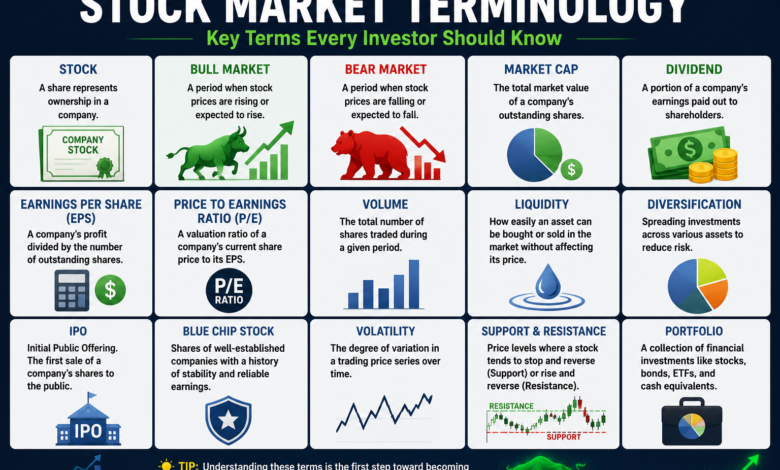
Stock Market Terminology can feel confusing when you first start reading about investing. Prices move constantly, financial news is filled with unfamiliar expressions, and even a simple conversation about shares can include terms that sound more complicated than they really are. Learning stock market terminology gives you a much easier way to understand what investors, analysts, and financial journalists are actually discussing.
You do not need to memorize an entire financial dictionary before buying your first stock. What matters is understanding the words that appear most often and knowing why they matter. Once the basics become familiar, market reports, company results, charts, and investment discussions become much easier to follow.
This guide breaks down important terms in plain language. Stock Market Terminology Some describe stocks themselves, while others explain trading activity, company performance, market movements, and investment strategies. Together, they create a practical foundation for anyone who wants to become more comfortable with the language of investing.
Why Stock Market Terminology Matters
Understanding stock market terminology is about more than sounding knowledgeable. The meaning of a financial term can influence how you interpret information and, ultimately, how you evaluate an investment decision.
Consider the difference between revenue and profit. A company can report rising sales while its profits fall because expenses increased. Without knowing what those terms mean, an investor could easily misunderstand the company’s financial position.
There is also a confidence factor. When you understand Stock Market Terminology phrases such as market capitalization, dividend yield, earnings per share, volatility, and price-to-earnings ratio, financial news becomes less intimidating. Instead of skipping an article because every other sentence contains unfamiliar language, you can focus on what the information actually means.
1. Stock
A stock represents ownership in a company. When you purchase shares of a publicly traded business, you generally become a shareholder and own a small portion of that company.
The value of your investment can rise or fall depending on the market price of the shares. Some companies also distribute part of their profits to shareholders through dividends.
Stocks can differ significantly in size, industry, risk, and growth potential. That is why simply knowing that you own “stocks” is not enough; understanding the company behind each stock matters too.
2. Share
A share is an individual unit of ownership in a company. The terms “stock” and “share” are often used interchangeably in casual conversation, although they can have slightly different meanings depending on context.
If a company has millions of shares outstanding, purchasing Stock Market Terminology 10 shares gives you a very small ownership interest. The percentage depends on the company’s total number of shares.
Share prices change throughout the trading day as buyers and sellers interact. That movement is one of the most visible parts of the stock market.
3. Market Capitalization
Market capitalization, often shortened to “market cap,” measures the total market value of a company’s outstanding shares.
The basic calculation is straightforward: share price multiplied by the number of shares outstanding. For example, if a company has 100 million shares and each share trades at $20, Stock Market Terminology its market capitalization would be approximately $2 billion.
Investors often use market cap to categorize companies as large-cap, mid-cap, or small-cap. These categories can provide useful context, although they do not automatically determine whether a stock is a good or bad investment.
4. Bull Market
A bull market generally describes a period when stock prices are rising or are expected to continue rising. Investor confidence tends to be stronger during these periods.
Bull markets can last for months or even years. Stock Market Terminology They may be supported by economic growth, improving corporate earnings, lower interest rates, or strong investor sentiment.
However, rising prices do not eliminate risk. Even during a bull market, individual stocks can experience significant declines.
5. Bear Market
A bear market is generally associated Stock Market Terminology with a substantial decline in stock prices and widespread pessimism among investors.
Bear markets can be uncomfortable because portfolio values may fall rapidly. Investors may become concerned about economic conditions, company profits, interest rates, or broader financial risks.
Historically, markets have experienced both bull and bear cycles. Understanding this concept is an important part of stock market terminology because it helps investors put short-term price movements into a broader market context.
6. Volatility
Volatility refers to how dramatically and quickly an asset’s price moves.
A highly volatile stock can rise or fall sharply over relatively short periods. Lower-volatility investments may experience smaller price fluctuations.
Volatility is not automatically negative. It simply describes movement and uncertainty. Stock Market Terminology For investors, the important question is whether the level of volatility fits their risk tolerance and investment objectives.
7. Dividend
A dividend is a payment that a company distributes to eligible shareholders, usually from its profits or accumulated cash.
Not every company pays dividends. Mature businesses with predictable cash flows may be more likely to distribute money to shareholders, while rapidly growing companies may reinvest profits into expansion.
Dividend payments can provide investors with a source of income in addition to any potential increase in the stock’s price.
8. Dividend Yield
Dividend yield compares a company’s annual dividend payment with its current share price.
For example, if a stock pays $2 per share annually and trades at $50, its dividend yield would be 4%.
Dividend yield can be useful when comparing income-oriented investments, Stock Market Terminology but a high yield should not automatically be considered attractive. Sometimes an unusually high yield results from a falling stock price or a dividend that may not be sustainable.
9. Earnings Per Share
Earnings per share, commonly called EPS, represents a company’s profit allocated to each outstanding share.
Investors often examine EPS when evaluating financial performance. Rising EPS can indicate that a company’s profitability is improving, although the reasons behind the change matter.
EPS is particularly useful when compared across different periods or against analyst expectations. A single number rarely tells the entire story.
10. Price-to-Earnings Ratio
The price-to-earnings ratio, or P/E ratio, compares a company’s share price with its earnings per share.
Investors often use the ratio to assess how much the market is paying for each dollar of earnings. A higher P/E can indicate that investors expect stronger future growth, Stock Market Terminology while a lower P/E may suggest more modest expectations.
Neither high nor low automatically means “good” or “bad.” Comparing a company’s P/E with competitors and its own historical valuation can provide more meaningful context.
11. Market Order
A market order instructs a broker to buy or sell an investment immediately at the best available price.
The main advantage is speed. If executing the trade quickly is the priority, a market order can be useful.
The drawback is that the final execution price may differ slightly from the price you saw when placing the order, particularly in a rapidly moving or less liquid market.
12. Limit Order
A limit order allows an investor to specify the maximum price they are willing to pay when buying or the minimum price they are willing to accept when selling.
This provides greater price control than a market order. However, there is no guarantee that the trade will execute.
For example, if you want to buy a stock only at $40 or lower and the market remains above $40, your order may never be filled.
13. Bid and Ask
The bid is generally the highest price a buyer is currently willing to pay. The ask is the lowest price a seller is currently willing to accept.
The difference between these two prices is known as the bid-ask spread.
A narrow spread can indicate strong liquidity, while a wider spread may occur in less actively traded securities. Understanding the bid and ask is a practical part of stock market terminology because these prices directly affect trade execution.
14. Liquidity
Liquidity describes how easily an asset can be bought or sold without causing a major change in its price.
Large, heavily traded stocks tend to have high liquidity because many buyers and sellers participate in the market.
Low-liquidity investments can be harder to trade efficiently. Investors may encounter wider bid-ask spreads or greater price movement when placing orders.
15. Portfolio
A portfolio is the collection of investments owned by an individual or institution.
A portfolio might contain Stock Market Terminology from several industries, along with bonds, funds, cash, or other assets.
The purpose of building a diversified portfolio is generally to avoid depending entirely on one investment or market segment. Different assets can behave differently under changing economic conditions.
16. Diversification
Diversification means spreading investments across different assets, companies, industries, or geographic markets.
The basic idea is simple: avoid putting all your financial exposure in one place.
Diversification cannot eliminate investment losses, but it can reduce the impact of a poor-performing investment on the overall portfolio.
17. Capital Gain
A capital gain occurs when an investment is sold for more than its purchase price.
For example, if you buy shares for $1,000 and later sell them for $1,300, Stock Market Terminology the difference represents a $300 capital gain before considering fees or taxes.
Capital gains can be short-term or long-term depending on how long the investment was held, with tax treatment varying by jurisdiction.
18. Capital Loss
A capital loss occurs when an investment is sold for less than its purchase price.
If shares purchased for $1,000 are sold for $800, the investor has a $200 loss before fees and taxes.
Losses are an unavoidable possibility in investing. Understanding them is just as important as learning about gains because markets do not move upward continuously.
19. Index
A market index tracks the performance of a selected group of securities.
Well-known indexes can provide a Stock Market Terminology snapshot of how a particular market segment is performing. Investors frequently use indexes as benchmarks when evaluating portfolios or funds.
Indexes are not direct investments themselves in the traditional sense, but investors can gain exposure to them through index funds and exchange-traded funds.
20. ETF
An exchange-traded fund, or ETF, is an investment fund that trades on a stock exchange.
An ETF can hold a collection of stocks, bonds, commodities, or other assets. Some ETFs are designed to follow specific indexes, while others focus on industries, strategies, regions, or themes.
Because one ETF can contain many holdings, it can provide diversification through a single investment.
21. Stock Market Index Fund
An index fund is designed to track the performance of a particular market index rather than trying to outperform it through frequent security selection.
The approach is generally based on passive investing. Stock Market Terminology Instead of constantly choosing individual stocks, the fund seeks to replicate an index’s holdings or performance.
This strategy has become popular because of its simplicity and, in many cases, relatively low costs.
22. IPO
An initial public offering, or IPO, occurs when a private company offers shares to public investors for the first time.
Going public can provide a company with access to additional capital and a broader shareholder base.
For investors, an IPO can be exciting, but newly public companies can also carry considerable uncertainty because there may be limited historical information available as a public company.
23. Trading Volume
Trading volume refers to the number of shares or contracts traded during a specific period.
High volume can indicate strong interest in an investment. Significant price movements accompanied by high volume may attract attention from traders and analysts.
Volume should not be interpreted alone, Stock Market Terminology though. Investors generally combine it with price action, company news, financial data, and broader market conditions.
24. Short Selling
Short selling involves selling borrowed shares with the expectation that the price will decline.
If the price falls, the trader can potentially buy the shares back at a lower price and return them to the lender, keeping the difference before costs and other considerations.
Short selling is substantially more complex and risky than simply buying shares. If the stock price rises significantly instead, losses can become very large.
25. Market Correction
A market correction generally refers to a meaningful decline in asset prices following a period of rising prices.
Corrections are a normal part of market behavior. They can occur because investors reassess valuations, respond to economic data, or react to changing expectations.
A correction does not necessarily mean that a long-term bear market has begun. Context is essential.
How to Learn Stock Market Terminology Efficiently
Trying to memorize dozens of financial definitions at once is rarely effective. A better approach is to learn terms in groups.
Start with basic concepts such as stocks, shares, market capitalization, dividends, and indexes. Once those are comfortable, move into trading concepts such as bid, ask, liquidity, market orders, and limit orders.
Finally, learn valuation and financial-analysis terms such as EPS, P/E ratio, revenue, profit, cash flow, and debt. Reading real company reports while studying these terms can make the definitions much easier to remember.
Final Thoughts
Learning stock market terminology is one of the simplest ways to become more comfortable with investing. You do not need an advanced finance degree to understand the language used by investors. Most common terms become surprisingly straightforward once they are explained in practical terms.
The bigger goal is not memorization. It is context. When you understand what a dividend means, why volatility matters, how market capitalization is calculated, and what a P/E ratio tells you, financial information starts making more sense.
Investing still involves risk, and knowing the vocabulary does not guarantee successful decisions. What it does provide is a stronger foundation for asking better questions, evaluating information more carefully, Stock Market Terminology and understanding what is actually happening in the market.
As your experience grows, these terms will become less like technical jargon and more like everyday financial language. That familiarity can make researching companies, reading market news, and managing an investment portfolio considerably easier.
You May Also Read