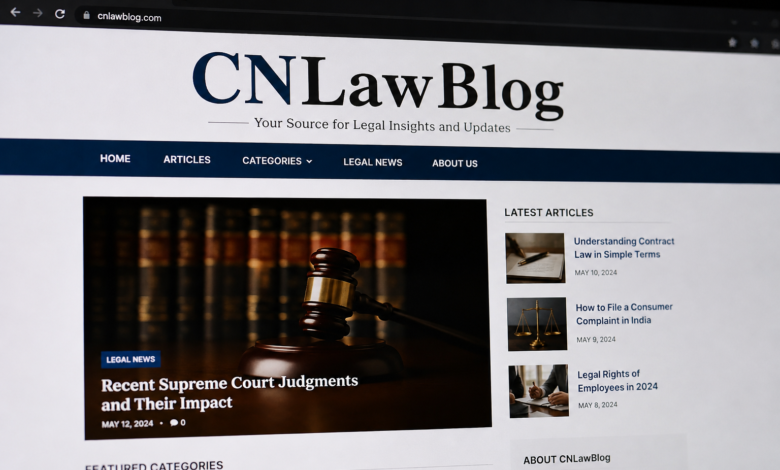
CNLawBlog Finding reliable legal information online can be harder than it looks. There are countless websites discussing laws, court decisions, business regulations, and legal rights, but the quality of those resources varies significantly. CNLawBlog is a term that may appear in searches from readers looking for legal commentary, explanations, and information connected with law.
Legal blogs can be useful because they often discuss complicated subjects in language that feels easier to understand than traditional legal documents. Instead of reading pages of legislation or lengthy court opinions, readers can find articles that explain the background, important terminology, and practical implications of a particular issue.
At the same time, legal content needs to be approached carefully. A blog post can help someone understand a subject, but it should not automatically be treated as personalized legal advice. Laws change, jurisdictions differ, and the details of an individual situation can completely change the answer. This article looks at what CNLawBlog represents as a search topic, why legal blogs matter, and how readers can get the most value from them.
What Is CNLawBlog?
The keyword CNLawBlog appears to refer to a legal-information or law-blog concept, but its exact meaning can depend on the website, domain, or page where the term is encountered. A name alone is not enough to establish the ownership, authority, or purpose of a particular online resource.
That distinction is important because search engines can return multiple pages targeting the same phrase. Some may be official legal resources, while others could be independent blogs, directories, archived pages, or websites using similar terminology.
Readers should therefore check the exact domain associated with CNLawBlog before assuming they are viewing an official legal organization. Looking at the site’s About page, author information, contact details, publication dates, and legal disclaimers can provide useful clues about what kind of resource it actually is.
Why Legal Blogs Have Become Popular

Legal subjects are often written in highly technical language CNLawBlog Statutes, regulations, contracts, and court opinions have precise meanings, but they are not always easy for ordinary readers to understand on a first attempt.
A good legal blog can bridge that gap. It may explain a complicated issue using examples, definitions, timelines, and plain-language summaries. That makes legal information more accessible to people who are researching a topic for the first time.
There is also a practical reason for the popularity of legal blogs. People frequently search for answers before deciding whether they need professional help. They may want to understand a legal term, learn how a process generally works, or discover what questions they should ask an attorney.
What Topics Might a Legal Blog Cover
A broad legal publication can cover many different areas. Common subjects include business law, employment matters, family law, property disputes, personal injury, intellectual property, immigration, taxation, contracts, and civil litigation.
The usefulness of an article often depends on how narrowly the subject is defined. A general article about employment law can provide background, while a focused discussion of a particular regulation may offer more detailed information for someone researching that issue.
For readers exploring CNLawBlog, it is worth identifying the site’s primary subject areas before spending time with individual articles. A publication specializing in corporate law, for example, may not be the best resource for someone researching family-law questions.
The Importance of Author Credentials
Legal information should be evaluated differently from ordinary lifestyle content. When an article discusses a serious legal matter, knowing who wrote it can make a significant difference.
A qualified legal professional may have practical experience that allows them to explain not only what a rule says but also how it can operate in real situations. Academic researchers and CNLawBlog experienced legal journalists can also provide valuable perspectives when their sources are clearly identified.
This does not mean every article written by a lawyer is automatically correct. Even experienced professionals can disagree about complex legal questions. Still, transparent authorship gives readers a useful starting point for evaluating the information.
Why Publication Dates Matter
One of the easiest mistakes in online legal research is relying on old information. Laws can change through new legislation, court decisions, administrative rules, or regulatory updates.
An article that was accurate several years ago may now be incomplete. That is particularly important in areas where regulations change frequently or where courts have recently issued significant decisions.
When reading material associated with CNLawBlog, check when the article was published and whether it has been updated. If an older article discusses a rule that affects an important personal or business decision, verify the current position using authoritative legal sources.
Legal Blogs Versus Official Legal Sources
A legal blog and an official government or court source serve different purposes. A blog generally explains, analyzes, or comments on legal information, while an official source provides the underlying law, regulation, filing, judgment, or government guidance.
For general education, blog articles can be easier to read. They may provide context that is missing from the original legal document and explain why a particular development matters.
When the consequences are serious, however, readers CNLawBlog should go back to the underlying authority. If a blog discusses a new court ruling, for example, locating the actual judgment or an authoritative summary can help confirm what the court actually decided.
How to Read Legal Articles Critically
Reading legal information critically does not mean assuming everything is wrong. It means understanding the difference between an explanation, an opinion, and an authoritative legal rule.
Pay attention to the language used. Statements such as “may,” “generally,” and “depending on the circumstances” can be important because legal outcomes often depend on specific facts. A responsible article should avoid presenting complicated legal questions as if there were always one universal answer.
Sources matter, too. Strong legal articles usually identify statutes, regulations, court decisions, official guidance, or other reliable references. If an important claim has no supporting source, readers should be cautious about treating it as established fact.
CNLawBlog and Legal Research
For someone using CNLawBlog as part of legal research, the best approach is to treat the material as one piece of a larger research process. Start with the article to understand the issue and identify unfamiliar terminology.
After that, locate the primary sources mentioned in the article. This two-step process can save time because the explanatory article gives you context before you approach technical legal documents.
You can then compare the information with current official sources. If there is a significant disagreement, that is a signal to investigate further rather than simply choosing the version that sounds more convenient.
Using Legal Blogs for Business Research
Business owners regularly encounter legal questions involving contracts, employees, intellectual property, privacy, taxes, partnerships, and regulatory obligations. A well-written legal blog can help business readers understand these subjects before they speak with a professional.
For example, an entrepreneur considering a new agreement might use legal commentary to learn about common contractual terms and potential issues. That preparation can make a later conversation with a lawyer more productive.
However, businesses should be particularly careful about applying general online information to a specific transaction. The wording of a contract, location of the business, industry regulations, and individual circumstances can all affect the legal position.
Legal Information for Everyday Readers
You do not need to be a lawyer to benefit from legal education. Ordinary life produces plenty of situations where understanding basic legal concepts is useful.
Renting a property, signing a contract, starting a business, dealing with an employer, buying property, or handling an insurance claim can all involve legal rights and responsibilities. A clear article can help a reader understand the vocabulary before deciding what to do next.
That educational role is one reason a resource such as CNLawBlog can attract readers beyond the legal profession. People often want a starting point rather than a complete legal strategy.
Common Problems With Online Legal Content
Not every legal blog deserves the same level of trust. Some websites publish articles primarily to attract search traffic, and their content may provide little original research or meaningful analysis.
Another issue is oversimplification. A headline might promise a definitive answer when the underlying legal issue is much more complicated. Readers should be skeptical of articles that make sweeping claims without discussing exceptions or jurisdictional differences.
There is also the risk of outdated information. A page can remain online for years after the law has changed. That is why publication dates, update notices, sources, and current official information are all important when researching legal topics.
How to Get More Value From CNLawBlog
If you come across CNLawBlog while researching a legal question, start by identifying exactly what the article is trying to accomplish. Is it explaining a legal concept, commenting on a court decision, discussing a recent development, or offering practical guidance?
Next, look at the author’s background and the sources supporting the article. A well-researched piece should give readers enough information to understand where its conclusions come from.
Finally, use the article as a starting point rather than the final word on an important matter. For everyday educational research, that may be enough. For a dispute, contract, legal claim, or other high-stakes issue, professional advice and current primary sources are much more appropriate.
The Future of Legal Blogging
Legal blogging continues to evolve as readers increasingly expect information to be understandable, current, and easy to navigate. Modern legal publications are competing not only with traditional law firms but also with government websites, online databases, newsletters, podcasts, and social media.
That competition can improve the quality of useful content. Readers have more choices and can compare different explanations of the same issue.
At the same time, the growing volume of online legal content makes source evaluation more important. A polished website does not necessarily indicate authoritative information. Accuracy, transparency, expertise, and up-to-date sourcing remain the stronger indicators of quality.
Final Thoughts
CNLawBlog is best understood as a search term associated with legal blogging and online legal information, rather than assuming the name automatically represents one universally recognized legal authority. The exact website, author, jurisdiction, and subject matter should always be checked before relying on its information.
Legal blogs can be excellent educational tools. They simplify technical concepts, provide context, highlight important developments, and help readers prepare better questions for qualified professionals.
Still, online articles have limits. Laws change, jurisdictions differ, and individual circumstances matter. If the information could affect your rights, finances, business, employment, property, or legal obligations, verify important claims through authoritative sources and consider speaking with a qualified legal professional.
Used thoughtfully, CNLawBlog and similar legal resources can make legal research less intimidating. The key is to read beyond the headline, check the source, consider the date, understand the jurisdiction, and never confuse general information with advice tailored to your specific situation.
You May Also Read