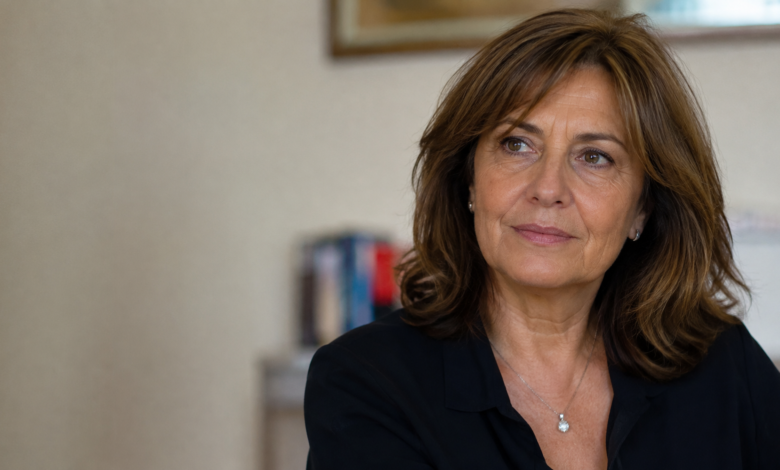
Emanuela Pecchia is an Italian contemporary artist whose work has gradually attracted attention through exhibitions, art platforms, and a distinctive visual style inspired heavily by the sea. Born in Latina, Italy, in 1990, she developed an artistic identity that combines expressive color, movement, texture, and large-scale compositions.
Her journey is particularly interesting because it has crossed several places and creative environments. After completing her artistic education in Italy, she moved to Barcelona in 2016, where she lived and worked for several years. She later relocated to the province of Palermo, where she continues her work as a full-time painter.
Unlike artists whose careers are built around one recognizable Emanuela Pecchia subject or traditional technique, Pecchia’s work has evolved around emotion and atmosphere. Water, waves, reflections, depth, and movement appear repeatedly in descriptions of her paintings. The result is artwork that can feel both abstract and connected to the natural world.
Who Is Emanuela Pecchia?
Emanuela Pecchia is an Italian visual artist and contemporary painter born in 1990 in Latina, a city in the Lazio region of Italy. Her formal artistic training began in her hometown, where she graduated from an art school before eventually taking her work beyond Italy.
Her career is centered primarily on painting. She works mainly with acrylic on canvas and has developed a style in which color and movement are more important than straightforward representation. Rather than simply reproducing a landscape, she uses visual impressions to suggest sensations associated with water, light, distance, and motion.
That approach gives her work an interesting balance. At first glance, some paintings can appear almost entirely abstract, but the colors and flowing forms often suggest oceans, currents, horizons, or underwater spaces.
The name Emanuela Pecchia has become increasingly associated with this contemporary, sea-inspired approach. Her work has appeared on international art platforms and in exhibitions, helping her reach audiences beyond her original Italian base.
Early Life and Artistic Education
Emanuela Pecchia was born in Latina in 1990 and grew up in an environment that later became an important source of inspiration. Her artistic education began locally, where she attended an art school and developed the foundations of her creative practice.
Formal training can have a lasting impact on an artist, but it does not necessarily determine the style that eventually emerges. In Pecchia’s case, her later work appears to have developed through a combination of technical experience, personal observation, and an ongoing interest in nature.
The connection between her early environment and her fascination with the sea is particularly noticeable. Descriptions of her work frequently refer to the Mediterranean and Tyrrhenian coasts as important emotional influences.
Instead of treating the sea simply as a landscape to reproduce, she appears to use it as a visual language. Waves can suggest movement, deep blue tones can create a feeling of calm or mystery, and changing reflections can represent emotional shifts.
Moving From Italy to Barcelona
A major chapter in Pecchia’s development began in 2016, when she moved to Barcelona. She lived in the Spanish city for nine years, making it an important part of her artistic and personal development.
Barcelona is known for its strong creative culture, architecture, galleries, and international art community. Living there gave Pecchia exposure to a broader artistic environment and placed Emanuela Pecchia her work within a more diverse cultural setting.
Her time in Barcelona also coincided with the development of a more recognizable professional identity. Art platforms record exhibitions connected to the city, including the group exhibition #DISCONNECTED at HUB/ART Barcelona in 2024.
After nearly a decade in Barcelona, she eventually moved again. That next chapter brought her back to Italy, where she is now based in the province of Palermo and continues painting professionally.
Emanuela Pecchia’s Artistic Style
One of the clearest characteristics of Pecchia’s work is her use of acrylic paint on canvas. Her paintings frequently employ large formats, allowing color and movement to occupy a substantial portion of the viewer’s visual field.
Her palette often includes deep blues, turquoise, white, black, and occasional metallic or sandy tones. These colors create associations with the sea without necessarily depicting a recognizable beach or coastline.
The paintings can feel energetic and peaceful Emanuela Pecchia at the same time. Broad gestures suggest waves or currents, while layered areas of color create the impression of depth.
This balance is central to the appeal of her work. A viewer can look at one of her paintings and interpret it literally as an impression of water, or more emotionally as a representation of movement, freedom, vulnerability, or change.
Why the Sea Is So Important to Her Work
The sea is arguably the defining recurring element in Emanuela Pecchia‘s artistic identity. Her professional biographies describe water as a major source of inspiration, particularly its waves, reflections, currents, transparency, and constantly changing surface.
There is something naturally suited to abstraction about water. It rarely looks exactly the same from one moment to another, and its appearance changes dramatically depending on light, weather, depth, and movement.
That gives an artist enormous freedom. Instead of painting a fixed object, Pecchia can translate the feeling of water into colors and gestures.
Her paintings therefore do not need to show a literal ocean. The viewer may see a horizon, a wave, or an underwater environment, but another person might simply experience the composition as an emotional landscape.
The Role of Color in Her Paintings
Color is one of the strongest tools in Pecchia’s work. Her paintings frequently use shades of blue and turquoise, creating a visual connection with water and open space.
Blue can produce very different emotional responses depending on how it is used. A dark blue can suggest depth and mystery, while lighter turquoise can create an impression of freshness or openness.
White adds another layer. In a sea-inspired Emanuela Pecchia composition, it can resemble foam, reflected light, or the movement of waves. When placed against darker shades, it can also make a painting feel more dynamic.
Her palette is therefore not merely decorative. Color becomes part of the subject itself, carrying mood and helping the viewer interpret the movement within the composition.
Large-Scale Paintings and Visual Impact
Another notable characteristic of Pecchia’s practice is her preference for large-format paintings. Working on a bigger canvas changes the relationship between the artwork and the viewer.
Small paintings invite close inspection. Large paintings can feel immersive. The viewer may notice the overall movement first and only later discover individual textures, layers, and gestures.
That quality works particularly well with Emanuela Pecchia ocean-inspired compositions. A large canvas filled with flowing blues and turquoise can create the sensation of looking into a broad body of water.
Her use of scale also supports the emotional side of her work. Rather than presenting a tiny snapshot of the sea, she creates an environment in which the viewer can mentally enter the composition.
Exhibitions and Public Recognition
Pecchia’s work has appeared in several exhibitions during the past few years. One documented example is #DISCONNECTED, held at HUB/ART in Barcelona from September to October 2024.
She also participated in Freedom & Beauty: the language of art in Barcelona in 2025. These exhibitions helped place her work within a broader contemporary-art setting rather than limiting it to online galleries.
In 2025, she received an “Attestato di Merito” associated with the Emanuela Pecchia UK Artist recognition at an international contemporary art event held at Espacio Gallery in London. Her work was also included in later international art activities.
Recognition at this stage of an artist’s career can be useful because it creates visibility among collectors, curators, galleries, and other artists. It does not define artistic quality on its own, but it can help expand professional opportunities.
Her Artwork Beyond Italy and Spain
The reach of Emanuela Pecchia is not limited to the places where she has lived. Her professional biography states that her works are held in private collections in Spain, Italy, France, the Netherlands, and Germany.
That international presence is meaningful for a contemporary artist. Private collections can introduce an artist’s work to new audiences even when there is no major museum exhibition involved.
Online platforms have also played a role. Pecchia has profiles on art marketplaces where viewers can explore her available works and learn about her practice.
The combination of physical exhibitions and online visibility reflects how contemporary artists increasingly build careers. A painter does not necessarily need to rely exclusively on traditional galleries to find an international audience.
Life in Palermo
After spending nine years in Barcelona, Pecchia returned to Italy and relocated to the province of Palermo. Current artist profiles identify Palermo, Italy, as her base.
The move brings her closer to the Mediterranean environment that has long influenced her artistic imagination. It is easy to see why that setting could complement a practice so strongly connected to water and coastal landscapes.
However, her work should not be reduced simply to geography. Emanuela Pecchia Living near the sea does not automatically determine an artist’s style. The important point is that Pecchia has consistently used the sea as an emotional and visual reference throughout her development.
Today, Palermo represents another chapter in that ongoing journey rather than a complete break from her Barcelona years.
The Emotional Side of Her Work
At its best, abstract art does not tell viewers exactly what to see. Instead, it creates enough space for individual interpretation. Pecchia’s paintings appear designed to work in that way.
A viewer might see strength in a turbulent composition, calm in a smoother field of blue, or vulnerability in a fragmented pattern. None of those interpretations necessarily has to be wrong.
Her professional statements describe an interest in emotional connection and in exploring themes such as identity, beauty, inner strength, and vulnerability.
That makes the artwork more personal than a straightforward depiction of nature. The sea becomes a metaphor for internal experiences rather than simply a physical subject.
Emanuela Pecchia and Contemporary Art
Contemporary art can sometimes feel difficult to approach because viewers expect a clear explanation before deciding what a work means. Pecchia’s paintings offer a different entry point.
Her compositions are accessible visually even when their meanings remain open. Someone does not need specialist knowledge of art history to appreciate movement, color, contrast, and texture.
At the same time, there is enough ambiguity Emanuela Pecchia for more experienced viewers to explore deeper interpretations. The relationship between abstraction and natural imagery gives the paintings room to evolve depending on the person looking at them.
That flexibility is one of the strengths of her artistic approach. The work can function as decoration, emotional expression, or a more thoughtful exploration of nature and identity.
What Makes Her Artistic Journey Interesting?
The story of Emanuela Pecchia is not based on overnight celebrity. It is a gradual creative journey shaped by education, relocation, experimentation, exhibitions, and professional recognition.
Her move from Latina to Barcelona and later to the Palermo area shows how changing environments can influence an artist’s development. Each location brought different cultural experiences while maintaining a connection to the Mediterranean.
The evolution of her style is equally important. Her current work combines abstraction with recognizable sensations associated with the ocean, allowing her to create paintings that are expressive without being completely detached from nature.
That combination gives her work a recognizable identity while leaving room for continued experimentation.
What Could Come Next for Emanuela Pecchia?
Pecchia’s career is still developing, which means there is plenty of room for her work to change. Artists often move through different periods, experimenting with new colors, materials, dimensions, and subjects.
Her existing focus on water provides a strong foundation, but it does not necessarily mean she will always paint the sea in the same way.
Future exhibitions could reveal whether she pushes further into abstraction, introduces new subjects, or explores different media. Her current work already shows a willingness to use color and movement as expressive tools.
For collectors and art followers, that evolution may be one of the most interesting parts of following her career.
Final Thoughts on Emanuela Pecchia
Emanuela Pecchia has built a distinctive identity within contemporary Italian art through paintings that explore color, movement, water, and emotion. Born in Latina and later based in Barcelona before returning to Italy, her career reflects a combination of personal experience and artistic development.
Her work stands out for its flowing compositions, strong acrylic colors, and recurring connection to the sea. Rather than simply copying a landscape, she transforms the feeling of waves, depth, light, and movement into abstract visual experiences.
Her exhibitions in Barcelona and other international art settings, along with recognition received in 2025, show that her work is gradually reaching a wider audience.
What makes Emanuela Pecchia particularly interesting is that her paintings leave room for interpretation. There is a clear connection to the Mediterranean, but the emotional meaning can change from one viewer to another.
As her career continues, her future work may reveal new directions while retaining the qualities that have already become central to her artistic voice: color, movement, depth, and an enduring fascination with the sea.
You May Also Read